
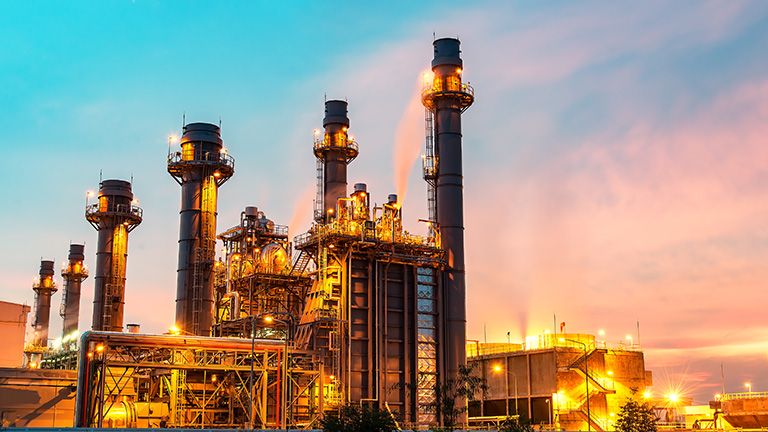
Chemicals and petrochemicals play an essential role in society, creating plastics, detergents, paints, synthetic fibres, medicines, fertilisers and much more. But it’s one of the most energy intensive and emitting sectors. How can it be decarbonised – and how can we get the needle moving on the dial now?
Chemicals and petrochemicals are essential, creating the platform for the production of plastics, synthetic fibres, building materials, electronics, paints, detergents, medicines, fertilisers, and much more. While demand is obviously high, the downside is that the manufacture of these products is energy-intensive, and carbon is not only used to generate heat but is also built into many of the products themselves.
Most of the sector’s direct emissions are associated with a relatively small group of primary chemicals, such as ammonia, methanol, and high-value chemicals (HVCs) such as ethylene, propylene, butadiene and aromatics. These chemicals are the building blocks for a huge range of downstream products. For example, ammonia production creates 85% of associated synthetic nitrogen fertiliser, which makes it a critical chemical for global food production.
Similarly, methanol is an essential base for solvents, resins, pharmaceuticals and many other compounds. High-value chemicals, meanwhile, are fundamental to the manufacture of plastics, synthetic fibres, and other polymers.
Petroleum fractions such as naphtha and petroleum gases are used as stocks for building block chemicals and polymers, such as benzene and polyethylene, while natural gas is used in the production of methanol and ammonia.
Production of all these chemicals continues to grow as demand accelerates. The sector is also highly reliant on fossil fuels, namely petroleum/oil by-products and gas.
According to a 2022 study by Lund University and ETH Zurich, direct greenhouse gas emissions (GHG) from the sector accounted for 1.8 Gt CO2 eq, or 4% of global GHG emissions. However, adding indirect emissions from industries that supply inputs for the petrochemical industry adds a further 3.8 Gt CO2 eq, bringing the total to 5.6Gt CO2 eq of GHG emissions, which equates to nearly 10% of global emissions. At the same the removal and incineration of used products accounts for even more energy usage and carbon dioxide emissions.
Emissions from petrochemicals and chemicals production are growing
The review also estimated that, over the last 25 years, emissions from the petrochemical industry have doubled, making it the third-largest emitting sector. It adds that BRIC countries account for 57%, with China alone responsible for 47%, the U.S. adds 6%, and Europe 5%.
Petrochemicals are also one of the largest industrial consumers of energy, accounting for 15% of global oil use and 8% of global gas demand – the sector uses around 50% more energy than iron and steel production. A further part of the challenge is that, even if all plants were electrified, carbon is still embedded in the products themselves.
As a result, the sector will need a portfolio of decarbonisation measures, applied to different points in the production and product lifecycle, rather than a single universal approach. The most credible transition combines demand reduction, efficiency, electrification, renewable feedstocks, circularity, carbon capture and — where necessary — carbon removal.
For example, electrification is particularly promising for heat processes. Electric steam-cracking technologies are being demonstrated, while heat pumps can address some low- and medium-temperature applications.
Renewable hydrogen and feedstocks, meanwhile, can replace fossil inputs in some processes. Renewable ammonia, for example, can be produced using green hydrogen and nitrogen separated from air.
In the same way, new sources of renewable methanol can be produced from biogenic feedstocks or synthesised from green hydrogen and a sustainable carbon source. Biomass can also provide alternatives for some petrochemical applications.
Bio-based ethylene, for example, is already produced commercially, although current volumes remain small compared with global fossil-based production. The problem is that few, if any, governments can absorb the costs associated with petrochemicals’ decarbonisation.
CCU is part of a diversity of approaches that can be adopted
Currently, multiple instruments are mooted to solve this problem. Of course, carbon capture and storage, carbon capture and utilisation, and direct air capture will have important roles where emissions are difficult to eliminate through other solutions.
But while such approaches are expected – eventually – to have a major impact, as yet they are unproven. And costly. We need other instruments to catalyse progress and to accelerate decarbonisation programmes.
In this mix, CCU can be part of the solution. That’s because captured CO₂ does not necessarily have to be treated solely as a waste stream and hence a cost. Where there is a suitable process, it can become a valuable source of products such as astaxanthin or phycocyanin – generating profit.
This creates opportunities. Because products derived from CCU can be profitable, both emitters and consumers have incentives that reduce investment costs and provide ROI, making such ventures financially viable. Moreover, consumers of such products can collaborate with emitters to create joint ventures, further spreading risk.
And this collaborative approach may also be advantageous when we consider how petrochemical producers are often located in clusters. For example, in the UK this includes locations such as Teesside and Humberside.
This clustering can be leveraged through shared infrastructure for carbon capture, transport, storage and utilisation, as well as potentially developing joint solutions – such as shared Special Purpose Vehicles (SPVs), alongside other joint measures – such as future CCS at scale.
What’s needed now, though, is just such a catalyst to spark decarbonisation programmes and to begin the long road to net zero. CCU is not a silver bullet, but it can bring compliance and economic benefits right now.
It is not an alternative to other solutions that will be viable in the future. But it is a complement to such approaches – and one that has significantly lower obstacles to viability. What’s more, it’s also ready for deployment in the shape of Remediiate’s unique, TRL8-ready solution which uses captured carbon to cultivate microalgae – and enables optimisation to deliver harvests of valuable offtake.
The chemical and petrochemical sector cannot decarbonise by relying on a single technology. Its emissions come from energy, process chemistry and the fossil carbon used as feedstock. Its transition therefore must address all three.
CCU adds another dimension, particularly in industrial clusters. Captured CO₂ can, under the right conditions, become a feedstock rather than simply a liability. Combined with innovative shared-risk models and commercially viable SPVs, for example, it could help overcome some of the investment barriers facing industrial decarbonisation.
If you want to kick-start decarbonisation in this tricky sector and get the needle moving now – talk to our team and find out how we can ease the transition.