
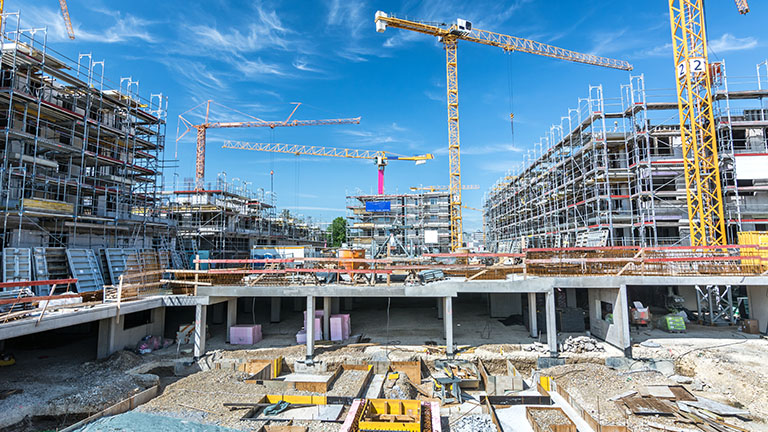
Right now, construction’s no friend to Net Zero. But what if we could both store and also make carbon a great building material? Could that change the game and support our Net Zero ambitions?
Here’s a headline you wouldn’t have seen even five years ago: Carbon Storage in Architecture: Can Algae Fibres Replace Structural Steel?
But if market momentum continues, the question it’s raising will become more and more rhetorical, and not a real query—as more and more CCU (Carbon Capture and Utilisation) products will get used by architects, such as cork-based flooring systems, timber, and bio-foams.
In the process profiled in Built Environment News, we learn how researchers at the Technical University of Munich have developed a method to capture carbon dioxide (CO₂) from the atmosphere and transform it into valuable carbon fibres, deliberately creating high-strength materials with broad applications.
In this approach to microalgae cultivation, a series of chemical and biotechnological processes is used to transform the algal oil into polyacrylonitrile (PAN) fibres, which are then carbonised using solar energy to create carbon fibres.
Given that the entire process removes more CO₂ than it emits, that makes it a viable pathway for long-term carbon storage. But what may surprise you is that this breakthrough occurred in 2019—and a lot more work has gone into cracking the microalgae-useful building materials lifecycle.
To take just one more example, other researchers have developed a way to create alginate-stabilised CEBs (Compressed Earth Blocks) that achieve a compressive strength of 6.82 MPa and a 26% reduction in thermal conductivity (from 0.69 to 0.48 W.m−1.K−1), thereby enhancing insulation and energy efficiency.
That’s impressive because it shows that a low-carbon, bio-enhanced material can deliver both structural performance and improved energy efficiency at the same time—something that is often difficult to achieve with sustainable alternatives.
Reaching nearly 7 MPa puts these blocks within a range suitable for many structural and load-bearing applications. For example, making them a viable alternative to more carbon-intensive materials like fired bricks or concrete in certain contexts, while that nice lower thermal conductivity means the material is a better insulator, reducing heat transfer through walls.
In practical terms, this improves building energy efficiency by helping maintain indoor temperatures—cutting heating and cooling demand over the building’s lifetime.
The work underlines not only how the use of alginate (a bio-derived compound often sourced from algae) enhances both mechanical integrity and thermal performance simultaneously—but also and just as significantly, how bio-based additives can upgrade traditional, low-carbon materials into high-performance building solutions.
A sector in dire need of a little Green help
If carbon-derived, bio-based inputs can meaningfully compete with conventional construction standards while delivering additional sustainability benefits, then, to be informal for a second, it really is ‘game on’ here for CCU as a construction industry input.
Why that matters, of course, is that construction is a notoriously anti-Green ecosystem. It’s resource-intensive, relies heavily on fossil fuels, and produces significant waste throughout the entire life cycle of a building, from material production to demolition.
UN data suggests the buildings and construction sector alone is responsible for approximately 37% of global greenhouse gas emissions and around 40% of all raw material extraction (cement production alone accounts for approximately 7–8% of global CO₂ emissions).
Against the backdrop of increasing attention to moving away from fossil fuels, incremental efficiency gains, while necessary, are no longer sufficient. A more fundamental shift is needed that actively seeks to make carbon a construction sector resource, not a problematic off shoot.
Carbon building materials, though, must not just be lower-emission alternatives; they must either store or utilise carbon as part of their production or structure. So, we can have low-carbon materials that aim to minimise emissions during manufacture, plus carbon-storing materials such as timber or other bio-based inputs that lock atmospheric carbon into the built environment.
Time to rethink carbon’s role in the built environment
Which is all well and good—but that headline (and all the others we’ll all be seeing more of soon) point to a third leg of this, carbon-utilising construction sector materials that use captured CO₂ as a feedstock.
In other words, CCU in construction that would involve taking CO₂—typically from industrial emissions—and embedding it into materials through chemical, mineral, or biological processes.
In concrete, for example, CO₂ can be injected during curing, where it mineralises and becomes permanently locked into the material; carbon can also be converted into aggregates, polymers, or binders that form part of construction products.
If we could industrialise all this, we’d soon end up with materials produced at vast scale, designed for longevity and that could be a superb form of long-term sequestration while simultaneously removing a lot of carbon-intensive inputs. Our common built environment becomes not just a source of emissions, but a distributed carbon sink.
Are we there yet? No. But we’re very, very close to opening this door. As it stands, carbon-derived materials must compete directly with well-established, low-cost alternatives. Critical in a safety-critical industry like construction, evolved CCU-friendly regulatory frameworks and certification standards, also take time to evolve, slowing adoption.
Not something that will happen overnight. Unless we start today?
There’s work to be done for sure in productising this, as material performance must meet stringent standards for durability, safety, and consistency.
Nonetheless, we already know that biological approaches to carbon utilisation work–and that in particular what we specialise in, microalgae-based systems, offer a proven pathway.
Why? Because microalgae are among the most efficient natural mechanisms for capturing CO₂, using photosynthesis to convert it into biomass at high rates.
Unlike mineralisation processes, which primarily store carbon, by the way, the biological approach to CCU transforms it into a range of organic compounds that can serve as inputs for materials.
And the possibilities are literally endless. Algae-derived biomass can be processed into binders, fillers, or additives that integrate into construction materials, potentially reducing reliance on fossil-derived or carbon-intensive inputs.
Because these systems can be deployed alongside industrial emitters, they also offer a route to capturing emissions at source and converting them into useful outputs within a relatively contained loop.
Bottom line: Biological CCU targeting construction use cases are increasingly viable, and the demand for alternative materials will continue to grow. Practical, battle-tested CCU offers a pathway that aligns the twin environmental and industrial objectives of reducing emissions while creating value from what was previously waste.
Trillions of tons of bad carbon use need balancing with good carbon use
To put this into context, the world’s built environment occupies about 3% of all the land on Earth but has hundreds of billions of square metres of buildings, tens of millions of km of roads and trillions of tons of materials, making it one the largest ecosystems we have.
After all, the built environment will not decarbonise through substitution alone. It will require a rethinking of carbon itself—not just as a liability to be managed, but as a resource to be used. Carbon building materials are an early expression of that shift—and here at Remediiate, we already have proven tech and processes to get you started.
Open the dialogue today to see what we can do together.