
Applying control to a dynamic, uncontrolled environment underlies everything Remediiate is trying to do.
In Yaron Ilan’s widely-reviewed 2022 scientific paper, his definition of CDP, the constrained disorder principle, was first offered: that, to function properly, all living systems need a certain amount of variability and unpredictability—but just as importantly, to stay healthy and adapt to change, that variability must remain within boundaries.
As an organising principle, CDP has attracted a lot of attention, as it so neatly distinguishes a machine, which we use to produce a predictable result under defined conditions, and the inherent, indeed glorious, variability of a living thing—variability that helps biological systems remain flexible and adapt to changing circumstances.
If it does anything, surely the constrained disorder principle argues that life depends not on eliminating variability but on keeping it within a suitable, adaptable range—and that understanding this balance may help us correct biological dysfunction.
Maintaining the conditions that support intended client growth and production outcomes
We contend that the idea that living systems are dynamic and cannot be managed effectively through rigid assumptions alone is highly relevant. Indeed, we are coming to believe it’s actually definitional to our approach to what can sometimes seem like CCU via chemistry but is really high-tech farming.
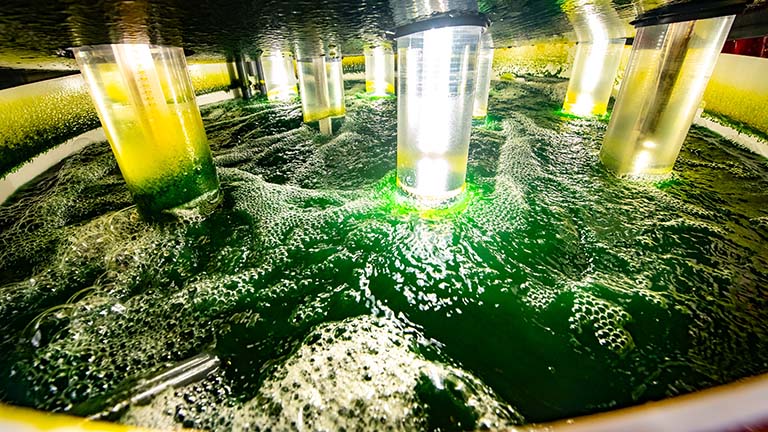
What we mean by that is biology can tell us what the organism needs and how it responds, but it’s really engineering alone that gives us the means to influence its environment. Aided by constant monitoring and feedback to help us understand whether those interventions are working, when we cultivate microalgae, we see ourselves as always trying to maintain conditions that support intended client growth and production outcomes.
In microalgae cultivation, factors such as light, temperature, nutrient availability, pH, mixing and gas exchange can influence growth and the characteristics of the resulting biomass. Their relative importance varies by species and process, and so altering one condition may also affect how the organism responds to others.
That means any non-trivial cultivation system cannot be designed around a static set of assumptions and expected to deliver the same result indefinitely. Conditions that support growth at one stage may need to be adjusted as the culture develops; a process that performs well under one set of circumstances may become less effective when the biological system changes.
In turn, that means any proposed microalgae-based system must be designed from the bottom up to accommodate a living process, rather than expecting the living process to conform to the limitations of the equipment. CDO thinking also tells us that we need to also never expect change won’t come along, too.
High-tech farming–just without the bantz
When you think about it, that isn’t that different for any kind of farming. As any season of Clarkson’s Farm will tell you, traditional farming is a constant effort to exert control, but a process that is at all times dependent on multiple factors outside your direct control, like the weather, sunlight, changing government regulations, local and global price changes, and so on.
Just like Jeremy, Kaleb and Charlie, we do what we can to maximise yield, too. But if you culture algae, sooner or later you reach a point where population collapse might be imminent, or growth rates slow; there’s always going to be uncertainty in the system.
But we would also argue we have constrained things down, using applied microalgae best practice, feedback loops, learning, and constant engagement with the wider science and our own IP to deliver as close to 100% optimal 24×7 regulation and growth.
Our customers tell us that means they can be sure of what the fields around The Farmer’s Dog can’t always: continuous, consistent harvest. Key to this is the level of conscious control and guardrails we put around every project. Microalgae cultivation is not just biology. Done right, it is a control engineering challenge.
We think that level of predictability is becoming increasingly important in the still-nascent CCS market. Players have come and gone, making headline-winning claims, securing awards and grants… and then disappearing.
The uncomfortable reality is, at least for now, because others have made claims that cannot be supported or sustained, we have a problem of credibility in the carbon capture and utilisation sector. It’s great that Yaron wrote his paper, but it’s a long way from amazing science to profitable business and dependable revenue streams.
We can’t go into it now (but would love to over a coffee at your offices when convenient), but our own company journey is one of seeing how microalgae wasn’t really being serviced properly with reliable, scalable and replicable means of being cultured—but the first team to do that, delivery and engineering were necessary accompaniments to the success of any potential microalgae-based CCU proposition, not just test tube clinking.
‘To achieve real CCU in the real world you need both science and engineering nous’
BUT you need to know your biology too! (CDP again!). Being, of course, prokaryotic, microalgae divide once a day, which places a limit on the number of harvests that can be collected; if you don’t know this and somehow build expectations of four harvests per day, not two, well, you’re going to come a cropper.
Why? Because to achieve real CCU in the real world, not just in conference papers or short-term R&D grant proposals, you need both science and practical engineering nous. Because we’re essentially trying to build a living system and not a machine here, the practical CCS microalgae engineer must anticipate how to manage those outcomes and changes.
So, if CDP showed us that any living, dynamic system responds to different conditions in different ways, any workable CCU design must have flexibility from the outset. From day one, at Remediiate we’ve tried to do that by striving to deliver consistent, controllable conditions for our agricultural process.
In essence, our biological expertise captures the variables we need to control the CCU process, dovetailing with the engineering knowledge that develops the closed systems that can affect that control.
We think we can sum this up by the market promise that if you work with us you can be sure we will always be applying deep understanding of the biological conditions that support efficient algal reproduction and growth while simultaneously applying engineering principles to build an environment that uses artificial light and innovative systems to control the relevant variables.
Make sense? Let’s set up that coffee meet to see how we can take some CDP out of your first moves into CCU, then.