
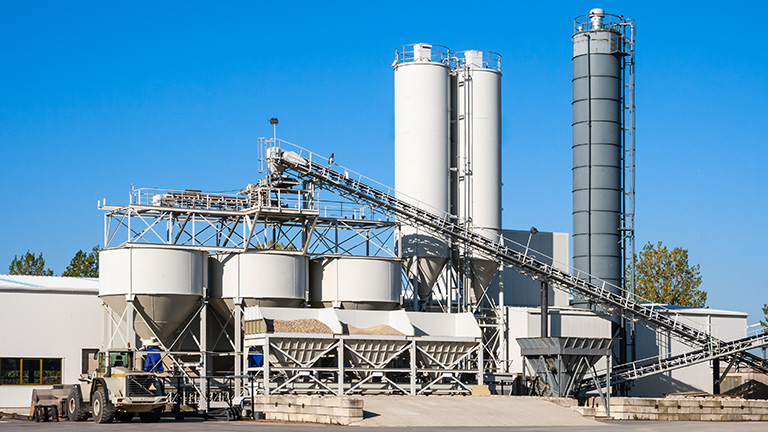
Cement and glass are essential global commodities, but their production is a significant source of CO2 emissions. It will be a major challenge to decarbonise both industries without an economically viable business model. What are the options?
Cement, bricks, concrete and glass are, of course, fundamental to building essential infrastructure. Cement is a global commodity that is manufactured everywhere – for buildings, construction, civil engineering projects, roads, and much more.
While cement comes in several varieties, the most common type is Portland – the production of which requires large quantities of clinker. This is produced by heating limestone to temperatures of around 1,400°C–1,500°C. At this point, the limestone reacts with clay or another aluminosilicate in a kiln to create the clinker, the base for making cement and concrete.
The clinker that results is then cooled, ground and combined with gypsum to produce cement. So, the production of clinker is essential to the production of cement, but it is also the most energy intensive part of the process requiring blistering temperatures.
The production of concrete is one of the biggest energy users and emitters
The amount of energy required to make cement and concrete is one of the highest energy-using industrial processes in modern times. But that’s not the only issue. Cement production creates substantial CO₂ emissions. Limestone is heated to high temperatures and calcined, which releases significant CO₂ emissions as part of the chemistry itself.
Those emissions cannot simply be eliminated by improving energy efficiency, electrification, or changing the fuel used in the kiln. The use of biomass or waste as an alternative is estimated to reduce energy requirements by just 2%.
These challenges make cement production one of the most difficult industrial sectors to decarbonise as, due to the high temperatures required, it’s not just a simple solution of switching from fossil fuels to electricity.
According to UN Climate Research and Network (UNCRN), which is part of the UN’s Environment Programme, cement accounts for 83% of total energy use in the production of non-metallic minerals and 94% of CO2 emissions, with energy representing 20% to 40% of the total cost of cement production. As well as the high temperatures required for creating clinker, a large amount of electricity is required for grinding the raw materials and cement.
The UNCRN also estimates that process carbon dioxide emissions account for around 3.5% of CO2 emissions worldwide and for 57% of the total emissions from cement production (through chemical processes), making it the third-largest cause of human-made CO2 emissions.
For cement, the problem starts with clinker
It adds that manufacturing industries as a whole account for one-third of global energy use, of which 30% is used for the production of iron and steel, 27% for non-metallic minerals (mainly cement), and 16% for chemicals and petrochemicals production.
Another source suggests that kilns for producing clinker consume in the range of 2.9 GJ to 7.5 GJ/ton of clinker produced, while the grinding of clinker consumes an average of 2.5 kWh/ton of clinker produced.
This consumption makes cement production costly. In terms of CO2 emissions, the same source estimates that global cement manufacturing produces about 1.47 billion metric tons of carbon dioxide annually.
However, the production of glass fares no better. Glass is made by melting a mix of silica sand, soda ash, and limestone inside a furnace at about 1,500°C to 1,700°C.
Global glass manufacturing produces roughly 86 to 95 million metric tons of carbon dioxide annually. Roughly 80% to 90% of these emissions come from burning fossil fuels to reach the extreme melting temperatures, while 10% to 20% come from raw material decomposition. For comparison purposes producing glass consumes between 5GJ and 7 GJ of total energy per ton.
Electrification will be essential but is not the full solution
Electrification will play a role in meeting these challenges, but does not remove the CO₂ released when limestone is converted into clinker. Electrification alone is not the solution.
There is also considerable scope for improvement when it comes to energy efficiency, including adjusting the mix of materials used for producing cement, better energy management, more modern equipment, improved kiln systems, more efficient grinding, and the use of alternative fuel sources. Trying to capture CO2 as calcination and including it in concrete increases the price per tonne of concrete by around £200, which may not be economically viable.
According to the same research by the UNCRN, cement plants in countries such as Belgium, France, the Netherlands, and Switzerland have experimented with a mix of used tyres, wood, plastics, chemicals and other types of waste, which are co-combusted in cement kilns in large quantities. They have been able to boost substitution rates from 35% to 70%, with some plants even reaching 100% – however, it relies on significant pre-treatment to ensure that waste products are usable in a kiln.
A multi-pronged approach to decarbonisation
The only viable option to solve the energy consumption and CO2 emissions issues facing the industry will likely be a multi-pronged approach. No single remedy will be sufficient.
There is a combination of levers that can be used, including:
- Using less clinker
- Improving production processes
- Experimenting with alternative fuels
- Capturing CO2 emissions
The latter is perhaps the most challenging. While CCS is considered a longer-term pathway, technical feasibility is different from economic and financial viability. CCS is currently cost prohibitive and requires transport of the captured carbon, as well as a suitable geological location to store it.
CCU, on the other hand, can capture emissions at source and convert them into resalable products, such as biomass or building materials, creating a new business model for carbon abatement. It’s already proven at scale and is significantly more cost-effective than CCS.
Rather than expecting every cement or glass producer to carry the full cost of capture, transport and utilisation on its own balance sheet, a special-purpose vehicle (SPV) could own or finance the relevant carbon-management assets – and profit from products produced as offtake, like animal feed, astaxanthin or phycocyanin.
Cement and glass producers and other participants could take an ownership stake, while the SPV generates revenue from the products or services associated with captured CO₂. Alternatively, downstream consumers can deploy the requisite infrastructure and secure ROI through the targeted production of selected offtakes.
In conclusion, cement and glass manufacturing are difficult to decarbonise because their footprint comes from both energy usage and emissions. The sector needs a portfolio of solutions, implemented according to the economics and technical characteristics of individual plants.