
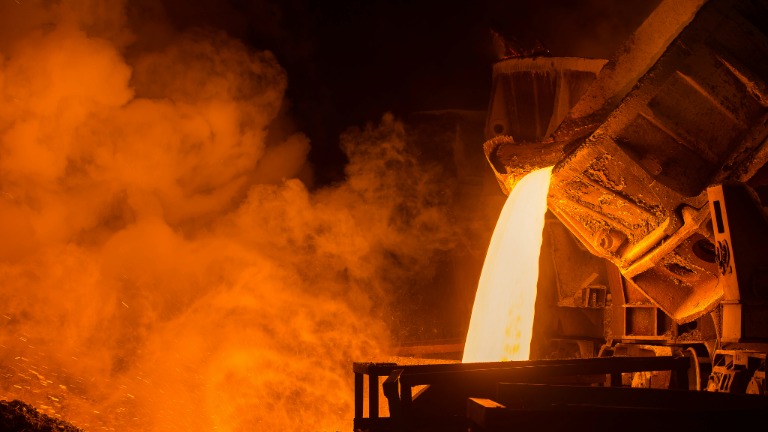
The iron and steel industry is one of the biggest emitters of carbon dioxide and the largest user of energy, mainly generated from coal-fired plants. How can the sector meet its carbon abatement obligations?
In July 2026, the UK government took British Steel into public ownership just 15 months after it had stepped in to prevent the closure of the steelworks in Scunthorpe (the last remaining UK producer of primary steel from iron ore), avoiding the loss of 4,000 jobs.
Peter Kyle, the then business secretary, announced that the plant is not currently profitable and would be supported by the government in the interests of national security.
The move highlighted the precarious nature of the steel industry and the thin, or absent, profit margins that can be obtained. As a result, UK steel production in 2025 fell to its lowest level in over a century.
The steel industry is facing historically low profitability margins
But it’s also a global issue. Excess capacity, oversupply, and price pressures have been eroding the profits of steel companies for decades to the point that profitability margins are now close to historic lows.
The industry is also grappling with increasingly stringent carbon abatement and CO2 emissions legislation. However, given the operating pressures, additional investment in Carbon Capture and Storage (CCS) solutions to boost abatement programmes is unlikely. What’s more, CCS remains unproven at industrial scale.
Of course, steel is essential and pervasive, being used in construction, building infrastructure (such as homes, hospitals, schools, bridges, and so on), transportation, machinery, tools, and – ironically – solar panel and wind turbine infrastructure and equipment.
Carbon plays a significant role in its production. It is essential in the steelmaking process as it acts both as a reducing agent to remove oxygen and other impurities from iron ore and helps to amalgamate iron and carbon, which is vital for creating steel.
Consequently, steelmaking is a carbon and energy intensive process – and typically dependent on fossil fuels. The industry is trying to embrace electrification using renewables, such as wind and solar, but these are intermittent energy sources and therefore not, as yet, suitable for intensive production of this critical resource. On the plus side, once manufactured, steel is indefinitely recyclable without any loss of its original properties.
The challenge ahead is twofold. On the one hand, more steel is needed. On the other, the production of steel results in significant emission of CO2.
Global demand for steel is set to increase by a third over the next 25 years
Demand is surging. According to the International Energy Association (IEA), global demand for steel is set to increase by more than a third between now and 2050.
The World Steel Organisation, estimates that in 2024, 1,886 million tonnes (Mt) of steel were produced with a total emission figure of 4.1 billion tonnes CO2e (75% direct emissions), representing up to 8% of global human related greenhouse gas emissions.
It also forecasts that, without targeted measures and actions, the sector’s CO2 emission will continue to rise to around 2.7 Gt CO2 annually by 2050, an increase of 7% on current emission levels.
Not all steel though is created equally, which means environmental impacts vary. Different processes are employed to produce different grades and types of steel. The primary route, which is typically used to produce new steel, depends on blast furnaces (Blast Furnace-Basic Oxygen furnaces, or BF-BOFs) rely on carbon-rich inputs. This route, which dominates the sector by far, emits around 1.8–2.0 tonnes of CO2 per tonne of steel. In the EU, 60% of steel is produced by the BF-BOF route.
On the other hand, the secondary route, through the utilisation of electric arc furnaces (which melt scrap steel and are powered by electricity), produces as few as 0.35 tonnes of CO2 per tonne of steel.
Emissions are also highly concentrated in specific regions, with just a few countries being responsible for the lion’s share of emissions. China, India, Japan, Russia and South Korea account for nearly 80% of emissions associated with the manufacture of steel – but of course, this is a global issue.
The iron and steel industry is struggling to meet net-zero targets. CCU must be part of the solution, not just storage
Global bodies that represent stakeholders in the steel industry are, generally speaking, aligned. They want the industry to enhance sustainability, reduce carbon emissions and meet Paris Agreement targets for net-zero. A broad consensus has long been in place.
The problem is that the industry does not expect to reach these targets within the defined time period. While a decline in emissions of 30% is anticipated, this is not enough. Such a reduction also comes at a high cost – impacting already thin margins and incurring significant costs.
So, what’s the industry to do? The industry is focusing on multiple technologies to accelerate carbon abatement, including hydrogen-based direct reduced iron (H₂-DRI), electric arc furnaces powered by renewables, and CCUS.
For example, around 70% of coal-fired blast furnaces are expected to require reinvestment by 2030, which offers a window of opportunity to switch to low-emission production.
But these efforts won’t go far enough. Analysts at Wood Mackenzie, part of Veritas Capital, note that CCUS – Carbon Capture Utilisation and Storage – has a role to play in helping accelerate this transition.
But, with storage as yet unproven at scale, attention should switch to the utilisation side of the equation, which can complement future storage activities. We need solutions today, so we can accelerate the journey. In particular, we should also note that local capture is essential – and many emitters are based far from storage infrastructure.
However, there are also innovative, proven technologies that are available now – for example, algal photosynthesis – and which can be deployed at the source of the emissions.
Remediiate’s Carbon Capture and Utilisation (CCU) solution, for example, captures carbon dioxide emissions at source, on site, requiring no transportation, and uses the natural process of microalgal photosynthesis to convert captured CO2 into offtake that can then be converted to create useful products that can then be sold as additional income streams, such as biomass and building materials.
These savings can then be directed to support other carbon abatement strategies and costs – and without impact on operating margins. Remediiate’s solution is proven at industrial scale and offers a far cheaper alternative to current approaches to storage.
Find out more by contacting our team.