
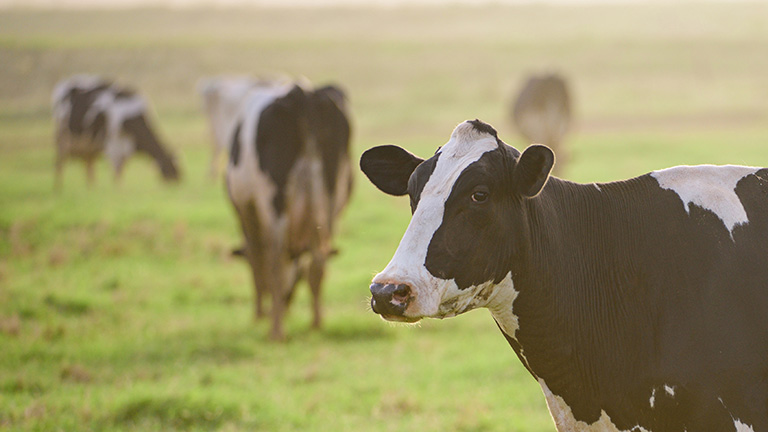
When a smoking chimney can give grazing cows something to smile about…
As the world gets unseasonably and uncomfortably hotter, interest is shifting to how to get as much industrially produced CO₂ out of the system as we can. But what if we could do that in a way that also transformed what is essentially waste into something that could help produce valuable animal feed?
Sounds like that timely new sub-genre of science fiction, cli-fi? Not at all, as utilising microalgae as means to do this is becoming a genuinely practical commercial technique.
The basic chemistry here is that microalgae are an alternative source material that can help reduce the use of certain other crops, such as soybeans. Rich in proteins, carbohydrates and oils, they can be used for human consumption but can also be made into a very useful circular raw material for animal feed – and make a significant contribution to the food chain.
As a result, a CO₂ → microalgae → high-value animal feed ingredients pathway emerges that CCU (Carbon Capture and Utilisation) managers could leap on, with both intangible (so, measured CO₂ utilisation / avoided emissions) ESG upside but also tangible revenue diversification possibilities, too, as people in sectors like aquaculture, poultry, and pet food are very much prepared to pay for functional nutrition inputs.
‘Among algae applications (biofuels, nutraceuticals, chemicals), animal feed is currently the most economically viable’
It’s important to note that microalgae to animal feed cultivation is one of the few CCU pathways that directly convert CO₂ into a marketable biological product, rather than a low-value mineral or storage outcome.
Forgive the very brief science reminder, but microalgae grow via photosynthesis, using photosynthesis which leverages solar power to fix CO₂, with water and nutrients to add to the mix. This process can be contained in controlled photobioreactors. As a result, we can use emitted CO₂ to fuel this process – and gain valuable harvest of nutrient-rich algae.
In industrial scenarios, flue gas or captured CO₂ is used as the carbon source, which outputs things like whole algal biomass that can be used directly in feed), lipids for omega-3 oil usage, and protein fractions that can be attractive in animal nutrition markets.
As things currently stand, among algae applications (biofuels, nutraceuticals, chemicals), animal feed is currently the most economically viable.
There are, of course, various ways to make all this happen, ranging from CO₂ supply direct to third-party algae producers to co-located algae production via facilities built next to a power or cement plant (which is the approach followed by Remediiate).
These firms demonstrate that algae-based feed ingredients are already commercially validated, not speculative. But the bottom line for CCU professionals is that microalgae systems can definitely offer a “carbon-to-product bridge technology” rather than pure sequestration, that revenue diversification becomes possible in parallel with all your decarbonisation efforts—and that your possibly currently very ‘dirty’ manufacturing site could become not just an emissions endpoint, but a biomanufacturing centre in its own right.
A partnership for making circularity happen
You may be interested to know that Remediiate already has a thriving partnership doing all of this with one of the major agricultural feed companies in the market, ForFarmers Group.
Based in the Netherlands but with operations and production sites in the UK, Germany, and Poland, this organisation produces and sells compound feed and feed blends for livestock, such as cattle, pigs, and poultry—in fact, 10 million tonnes of this stuff every year.
And in terms of converting CO₂ into useful products, as of late 2024 we’ve been working together to, in the words of the Group’s COO, Rob Kiers, “create value for our animal feed industry, but also contribute to a sustainable future”.
Kiers adds that the partnership is also a step towards greater ecosystem circularity, which is one of the industry’s core sustainability ambitions. Given how achievable it’s now becoming to turn your CO₂ into something even Jeremy Clarkson’s beloved cows would be happy to eat, then maybe it should be one of yours, too.