

Carbon Capture and Utilisation is part of a range of solutions to the problem of carbon emissions reduction – but it’s also perhaps the most mature of the approaches available to us today.
In particular, the use of captured carbon to drive algal photosynthesis already offers a profitable route forward – accelerating carbon reduction and paving the way for other approaches in the future.
CO2 reduction is, naturally, at the core of many corporate social responsibility objectives – and, because of growing legislative pressure, it’s also climbing the compliance agenda. Industrial emitters need to act – but are understandably wary of the costs. However, there’s already a way to help meet reduction goals that generates profit.
CO2 reduction using Carbon Capture and Utilisation
Carbon Capture, Utilisation and Storage is a broad term that covers a multitude of approaches to carbon emissions reduction. Essentially, these can be split into two categories, CCU and CCS.
CCU (Carbon Capture and Utilisation) involves capturing carbon emissions at their source, for example a waste gas flue in a factory or cement plant. The captured emissions are then converted into other products – examples include livestock feed, fertilisers, biofuels, and building materials.
CCS (Carbon Capture and Storage) is designed to permanently store carbon captured from these emissions but that also needs the right kind of storage facility. Abandoned mines, depleted subsea gas extraction facilities and so on are typically proposed as storage centres and many trials have been initiated globally.
However, these storage facilities may be distant from the source of emissions, which means that transportation needs to be considered, either through the build-out of new pipeline infrastructure or complex logistical operations.
While CCS will undoubtedly play a significant role in carbon mitigation, it appears that adoption at scale remains some way off.
As a result, attention is turning to the products that can be generated through CCU solutions. If these can be produced at scale and for profit, we can take positive steps towards our overall carbon reduction goals while CCS matures as an approach. We can use CCU as a lever to fund and build a circular carbon reduction economy and, ultimately to support investments in other approaches like CCS.
The potential to achieve this has already been noted. For example, the Oil and Gas Climate Initiative reckons that CCU could account for between 10 and 33% of all captured carbon by 2050. It also thinks that the current market has already reached 250 million tonnes per annum (Mtpa) of CO2 – but with enhanced production and increased diversity of utilisation pathways, this could reach 840 Mtpa by 2024.
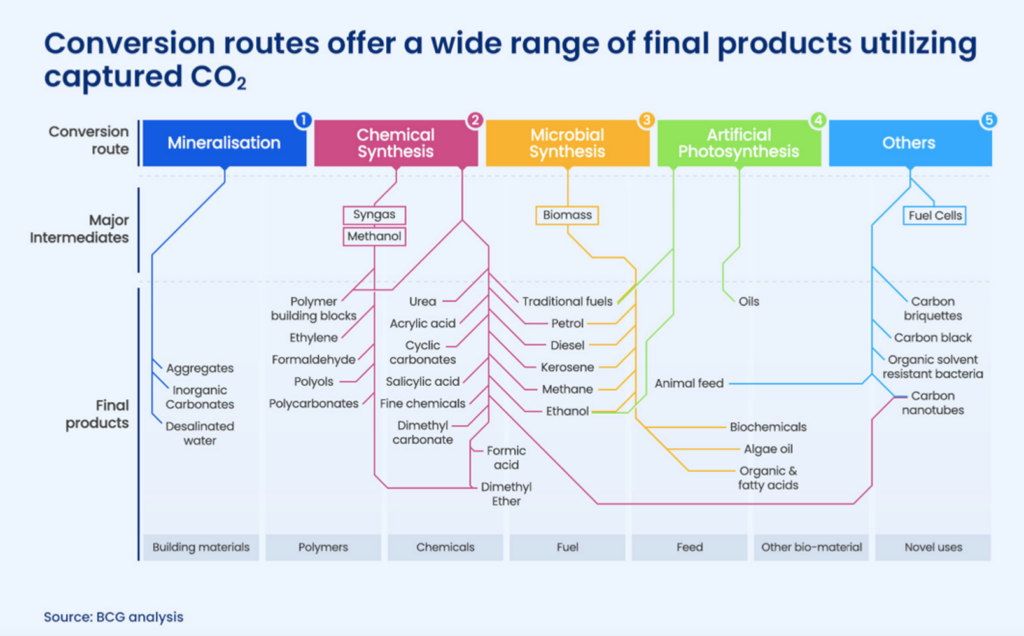
Separately, Boston Consulting Group has attempted to catalogue products that can be derived through CCU, using different pathways and techniques. These – and the resulting products – are summarised in Figure 1.
Figure 1: Source: Boston Consulting Group
Carbon reduction using algal photosynthesis
As can be seen, among several options, CCU can be achieved through processes like photosynthesis – the process through which photosynthetic organisms sequester CO2 and light to synthesise carbohydrates to support their growth.
For this to make an impact and to be viable as an approach to CCU, we need a way of harnessing photosynthesis in a captive environment to product biomass and the ability to harvest the resulting product at sufficient scale and regularity to deliver profit.
Ideally, we would boost the concentration of CO2 in the captive environments to accelerate growth and boost harvest. If we do that, then we also need organisms that can thrive in such an artificially carbon-rich environment: microalgae.
So, if this natural capacity can be leveraged and if we can deliver the right growing conditions, then we can capture carbon at scale and deliver those valuable products.
That’s what we’ve done at Remediiate. We’ve developed a process that enables the cultivation of microalgae, at scale, using our technology and photobioreactors to ensure optimised growth and harvest. We can deliver offtake that can be used for animal feed, agricultural products – even building materials.
As a result, we have delivered an approach to CCU that captures carbon and does so profitably – and which can be deployed by industrial emitters, today. Figure 2 zooms in to give a snapshot of our unique process.
Figure 2.
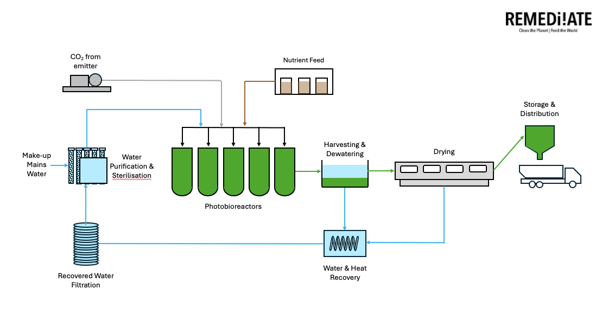
Our solution for carbon reduction captures industrial CO2 emissions at source from the flue, removing Scope 1 liabilities for the emitter at source. The purified CO2 supports the growth of microalgae – from which different products can be secured.
The proprietary technology we have developed provides unprecedented growth rates and yields that create a new profitable business model for biomass-based carbon reduction. Our solution perfectly complements future CCS approaches, helping you to diversify your abatement strategies – but it’s deliverable today.
Contact us if you would like to find out more.